


Sawer Singh Jamwal
India’s farms have sustained agricultural growth, but long-term productivity depends on healthy soils and resilient ecosystems. Regenerative agriculture offers a pathway to restore soil vitality, improve biodiversity, and strengthen resilience against climate stresses. Across the country, farmers are adopting practices such as natural farming, agroforestry, micro-irrigation, integrated farming systems, and scientific soil management. Government support has accelerated this transition. As of March 2026, natural farming clusters covered 8.80 lakh hectares and enrolled 18.19 lakh farmers. About 109 lakh hectares have been brought under Per Drop More Crop as of May 2026. In addition, 25.89 crore Soil Health Cards have been generated since inception, as of March 2026. These efforts are helping build a more productive, resource-efficient, and environmentally responsible future for Indian agriculture.
The Imperative for Regenerative Agriculture
India’s agriculture and allied sectors have demonstrated strong and sustained progress. During FY16-FY25, it recorded decadal growth of 4.45 percent, the highest in previous decades. This achievement reflects the resilience of the sector and the continued efforts of farmers across the country. Yet, sustaining this momentum requires strengthening the ecological foundations that support long-term agricultural productivity.
Each season, farmers return to the same fields with renewed hope and growing responsibility. Years of intensive cultivation, heavy chemical use, and erratic rainfall leave many soils tired and less responsive. Yields that once came easily now demand higher inputs, while heatwaves, dry spells, or excess rain can undo months of labour. For millions of small and marginal farmers, declining soil health often translates into higher costs and uncertain harvests. As a result, the sustainability of farming has become an increasingly important concern.
This is where Regenerative Agriculture finds its relevance. By rebuilding soil vitality, strengthening ecosystem functions, and improving resilience to climatic variability, it addresses both soil and productivity challenges. More importantly, it offers a pathway to revive India’s agricultural foundations while supporting long-term environmental balance and farm prosperity.
Understanding the Regenerative Agriculture Approach
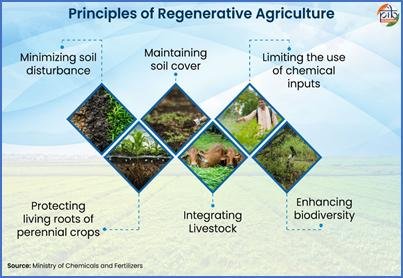
Regenerative agriculture is a holistic farming approach centred on restoring soil health and enhancing biodiversity. At the same time, it seeks to ensure long-term productivity and resilience in farming systems. Healthy soils support higher food and nutritional output, store more carbon, and promote biodiversity. Unlike sustainable farming, which primarily aims to maintain existing conditions, regenerative agriculture seeks to improve them. It goes a step further by actively rebuilding soil health, enhancing biodiversity, and strengthening ecosystem resilience
It is based on the following principles:
Minimizing soil disturbance
Protecting the living roots of perennial crops
Maintaining soil cover
Integrating Livestock
Limiting the use of chemical inputs
Enhancing biodiversity
Strengthening Agricultural Resilience through Regenerative Approaches
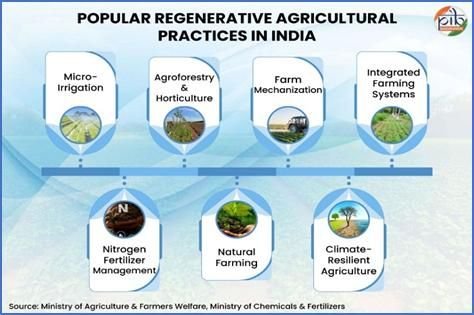
Regenerative agriculture draws upon a diverse set of farming practices adopted in India. While the spectrum of regenerative approaches is much broader, some of the prominent practices can be broadly classified into the following categories:
Water and Resource Efficiency
Micro-irrigation.systems such as drippers, sprinklers, and foggers deliver water directly to plant roots. This reduces water wastage and improves water-use efficiency. By optimizing farm-level water management, these systems enhance crop productivity and strengthen resilience to droughts and water stress. As a result, farming systems become more climate-resilient and economically viable.
Farm Mechanization involves the use of agricultural machinery and equipment to streamline and automate various farm operations. It helps optimize the use of key inputs such as water, fuel, and fertilizers, reducing wastage and lowering the carbon footprint. By enabling timely and precise farm operations, mechanization improves resource management, enhances productivity, and helps reduce the environmental impact of farming.
Soil and Nutrient Management
Nitrogen Fertilizer Management helps reduce nitrous oxide emissions while improving crop productivity. It focuses on selecting the right fertilizer and optimizing application timing and dosage. Other practices include deep placement of supergranular urea and the use of leaf color charts for precise assessment of nitrogen status. The approach also promotes biological inputs such as cyanobacteria and legume intercropping. Overall, these measures improve nitrogen-use efficiency and minimize environmental losses.
Natural farming is a chemical-free agricultural approach
rooted in India’s traditional knowledge systems. The system relies on on-farm biological inputs such as Beejamrut, Jeevamrut, GhanJeevamrut, Neemastra, and Dashparni, prepared using inputs from native livestock. It also promotes the use of traditional seed varieties and the integration of trees along farm boundaries. Pest management is undertaken through locally prepared, on-farm botanical formulations. Practitioners are encouraged to adopt continuous cover cropping, multi-cropping, mulching, and minimal soil disturbance to maintain soil fertility and ecological balance. The integration of livestock with diversified cropping systems further helps improve soil health, restores ecosystems, and reduces input costs for farmers.