

SRINAGAR — The rollout of the Pradhan Mantri Surya Ghar Muft Bijli Yojana (PMSGMBY) across Kashmir has reached a decisive turning point, with domestic solar installations expected to accelerate sharply, according to Union Power Secretary Pankaj Aggarwal.
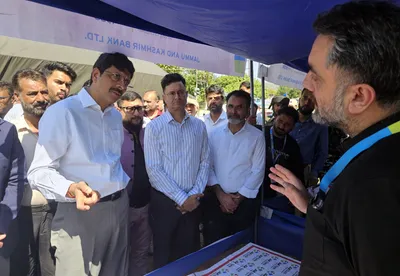
Speaking during an inspection of a Seva Setu Abhiyan awareness and outreach camp in Srinagar, Aggarwal noted that large-scale infrastructure programs typically encounter a gradual setup period before hitting their stride. Based on ground assessments, he stated that Kashmir has now transitioned into this high-growth phase, backed by visible enthusiasm from equipment vendors, local suppliers, and institutional financing partners
Progress and Regional Disparities
According to Mehmood Shah, Managing Director of the Kashmir Power Distribution Corporation Limited (KPDCL), Jammu and Kashmir has brought roughly 43,000 homes under the rooftop solar fold so far:
Kashmir Division: 26,000 households
Jammu Division: 17,000 households
Within the valley, adoption rates vary significantly by district. Installations are proceeding briskly across Srinagar, Kupwara, and Budgam, whereas uptake in districts such as Baramulla and Bandipora continues to trail behind targets.
Administrative Focus: Subsidies and Distribution Upgrades
Aggarwal outlined that his visit centered on reviewing the Union Territory’s broader electrical infrastructure, particularly the rollout of rooftop solar alongside network upgrades under the Revamped Distribution Sector Scheme (RDSS).
Addressing financial processes, he explained that the direct distribution of central subsidies through the Ministry of New and Renewable Energy’s digital platform is running efficiently. However, he identified the local administration’s supplementary top-up subsidy as an area requiring administrative refinement, confirming plans to address the bottleneck directly with the J&K Chief Secretary.
On a national scale, Aggarwal highlighted India’s broader renewable expansion, noting that total installed solar capacity—heavily supported by large ground-mounted farms in states like Rajasthan, Gujarat, Karnataka, and Andhra Pradesh—has reached roughly 165 GW.