
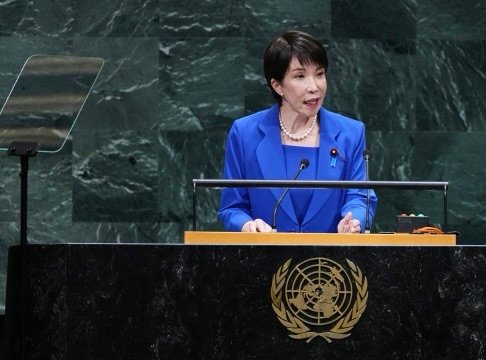

Japan has renewed its call for the United Nations to eliminate the references to “enemy states” that remain in its founding Charter—provisions that date back to the aftermath of the Second World War.
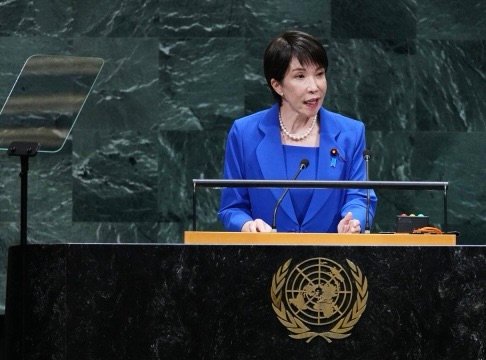
Japanese Prime Minister Sanae Takaichi raised the issue during her first address to the United Nations General Assembly on September 22. Her demand comes at a time when Tokyo’s relations with China and Russia have become increasingly tense, particularly over security and defence matters.
But what exactly is an “enemy state” under the UN Charter? Why were these provisions included in the first place, and why does Japan now want them deleted?
How the ‘enemy state’ provisions came into existence
The Second World War was fought primarily between the Allied Powers and the Axis Powers. The Allied coalition included countries such as Britain, the United States and the Soviet Union, while Germany, Italy and Japan were the principal Axis powers.
Japan surrendered in September 1945, bringing the war to an end.
The United Nations Charter was negotiated during the closing stages of the war and formally came into force on October 24, 1945. Given the circumstances in which the organisation was created, the Charter contained provisions specifically concerning states that had fought against the Allies.
These provisions were intended to provide the victorious powers with legal flexibility to prevent the return of aggressive militarism in former Axis countries. In certain circumstances, action against these states could be undertaken without following the normal requirement of obtaining prior authorisation from the UN Security Council.
References to “enemy states” appear principally in Articles 53, 77 and 107 of the Charter.
What does Article 53 say?
Article 53 deals with enforcement measures undertaken through regional arrangements. It establishes a general requirement for Security Council authorisation, while creating an exception for measures concerning an “enemy state” in circumstances linked to the Second World War.
The second paragraph of the article provides the definition. In essence, an “enemy state” means a country that was an enemy of a signatory to the UN Charter during the Second World War.
What is Article 107 about?
Article 107 preserves the validity of certain measures that the governments responsible for them took, or authorised, as a consequence of the Second World War against states that had been wartime enemies of Charter signatories.
Put simply, the provision was designed for the immediate post-war environment. It recognised that the victorious powers might need to take action against former Axis countries without first obtaining fresh approval from the newly created Security Council.
This was an exception to the broader post-war principle restricting the use of force in international relations.
What about Article 77?
Article 77 refers to the UN trusteeship system. Among the territories that could come under this framework were territories separated from former enemy states as a consequence of the Second World War.
The trusteeship system was established to oversee territories whose populations had not yet achieved full self-government. A number of such territories existed, particularly in Africa and the Pacific, during the early decades of the UN.
Why does Japan want these provisions deleted?
Japan has repeatedly argued that the “enemy state” provisions no longer have a meaningful place in the modern international system.
The issue is not new. The UN General Assembly recognised the provisions as obsolete in 1995. Ten years later, in 2005, the General Assembly adopted a resolution calling for references to “enemy States” to be removed from the Charter.
However, formally changing the UN Charter requires a difficult amendment process, including approval involving the permanent members of the Security Council.
The five permanent members—the United States, Britain, France, Russia and China—possess veto powers within the Council. There has not been sufficient political agreement to complete the process.
One concern surrounding Charter reform is that removing one outdated provision could open the door to broader demands for institutional changes, particularly changes to the composition and powers of the Security Council.
Japan links the issue to wider UN reform
Prime Minister Takaichi’s latest appeal was not limited to the “enemy state” provisions.
She also called for a broader restructuring of the UN Security Council, arguing that its current composition reflects the geopolitical circumstances of 1945 rather than today’s international environment.
Japan supports increasing the number of both permanent and non-permanent members of the Council. Tokyo argues that a larger and more representative Council would better reflect the contemporary international community.
Japan has itself sought a greater role in the UN system and has been associated with efforts to reform the Security Council.
Why has the issue become particularly sensitive now?
The renewed discussion comes against a backdrop of deteriorating relations between Japan and both China and Russia.
Japan and China have faced disagreements over security, military activity and regional strategic issues. Tensions also increased after Takaichi indicated last year that Japan could potentially respond militarily in certain circumstances involving an attack on Taiwan.
China regards Taiwan as part of its territory, while Taiwan operates under its own democratic government.
Economic tensions have also emerged, including Chinese restrictions affecting supplies of rare-earth-related materials important to Japanese industries. At the same time, Chinese military aircraft and naval vessels have conducted activities in waters and airspace near Japan.
Russia has likewise criticised Japan’s proposed increases in defence expenditure and has conducted military activities in areas close to Japanese territory.
The two countries have also invoked the “enemy state” provisions in their diplomatic arguments concerning Japan.
China and Russia invoke the clauses differently
China has defended the continued existence of the provisions as part of the legal framework established after the Second World War. Beijing has argued that the clauses remain connected to the post-war international order.
Russia has also referred to the provisions while discussing its long-running territorial dispute with Japan over the southern Kuril Islands, which Japan calls the Northern Territories.
The dispute remains unresolved.
Russian President Vladimir Putin’s visit to the contested islands in August further intensified Japanese criticism. Takaichi described the visit as deeply objectionable to Japan.
What happens next?
The references to “enemy states” are widely regarded as remnants of the immediate post-World War II period rather than provisions designed for today’s international relations. However, removing them requires formal amendment of the UN Charter, making political agreement among the permanent Security Council members crucial.
Japan’s renewed demand therefore forms part of a much larger debate over whether the structures created in 1945 adequately represent the political and security realities of the 21st century.
For Tokyo, eliminating the “enemy state” language is both a matter of removing an outdated reference and part of its broader argument that the United Nations, particularly the Security Council, needs institutional reform to reflect the contemporary international order.