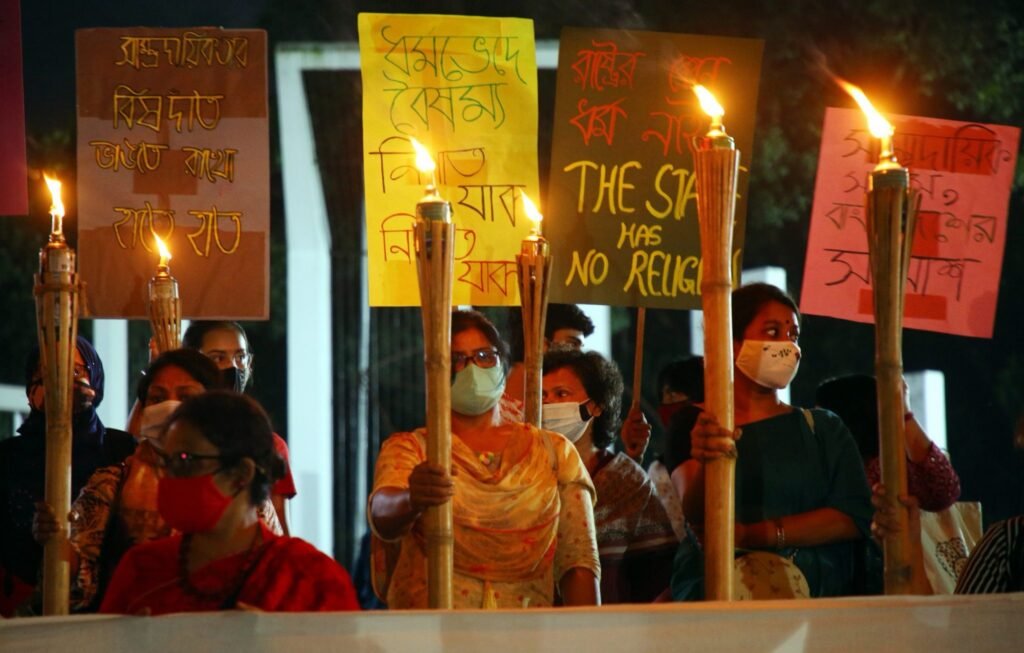

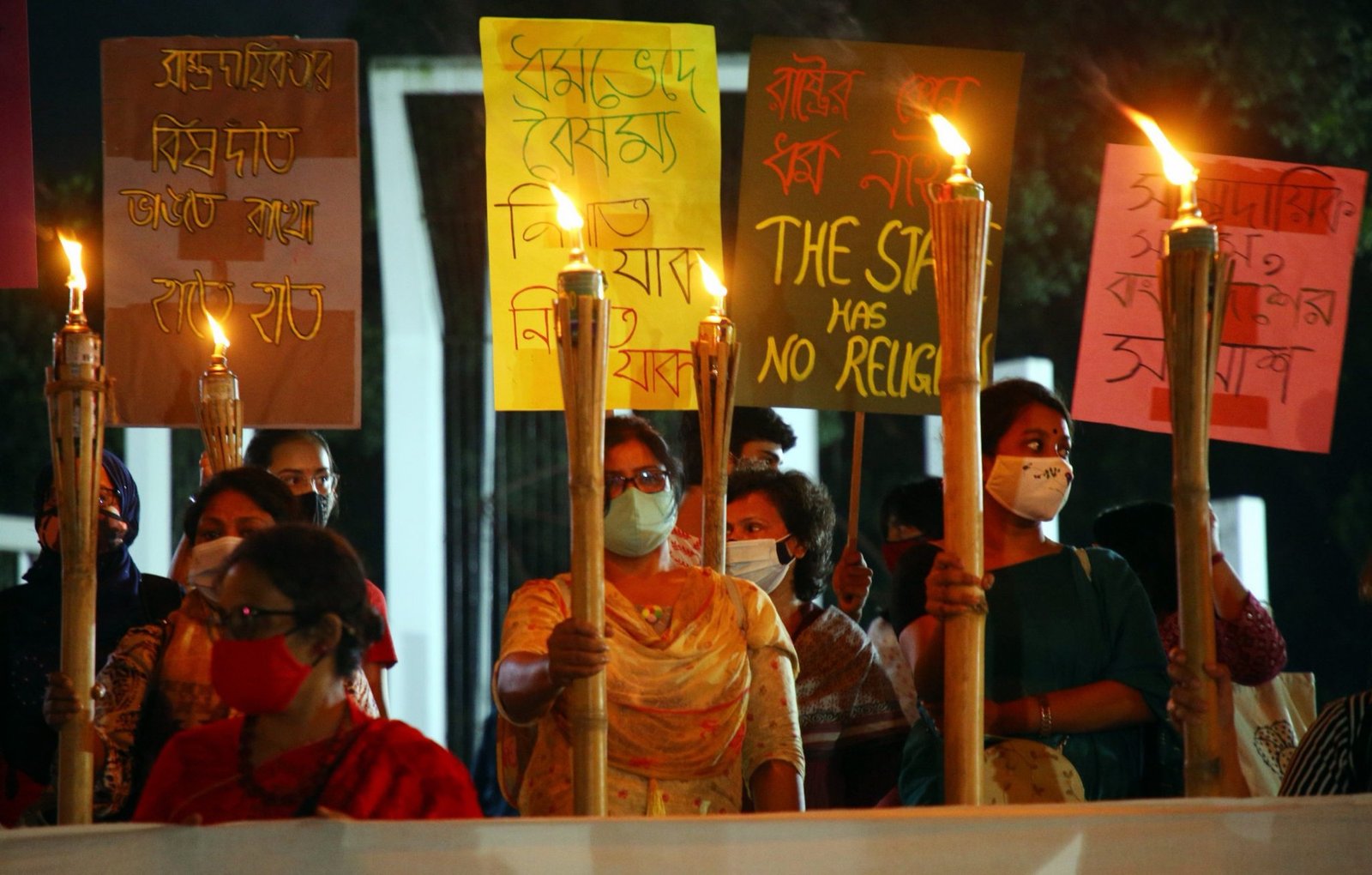

The country’s liberation was a rejection of political domination and majoritarian injustice. That history places a special responsibility on Bangladesh to safeguard the rights of its Hindu and other minority citizens.
Manzoor Naik
Bangladesh’s continuing reports of attacks on Hindus and other minorities raise a question that goes beyond the immediate incidents of violence. They compel Bangladesh to look back at the circumstances of its own birth and ask whether the lessons of 1971 are being adequately remembered.
The history of Bangladesh is, in many ways, a powerful reminder that a country cannot be held together merely by a shared religion. Pakistan was created in 1947 on the premise that Muslims required a separate political homeland. Yet within less than a quarter of a century, the country itself fractured. The people of East Pakistan, overwhelmingly Muslim, found themselves politically marginalised, culturally alienated and subjected to military repression by a ruling establishment dominated by West Pakistan.
As documented in In Pursuit of Peace, the events leading to Bangladesh’s liberation were rooted in the refusal to honour the democratic mandate of the December 1970 general election, in which Sheikh Mujibur Rahman’s Awami League secured an overwhelming majority. The denial of that electoral verdict and the subsequent military action transformed a political crisis into a devastating conflict that ultimately culminated in Bangladesh’s liberation in 1971.
The lesson is unmistakable: when political power ceases to respect equality, democracy and the dignity of citizens, religion alone cannot hold a nation together.
India’s role in 1971 must not be forgotten
Bangladesh’s liberation was fundamentally the achievement of the Bengali people and their freedom fighters. But it is equally important to acknowledge, without hesitation or historical revisionism, the extraordinary role played by India.
When violence engulfed East Pakistan, millions of refugees crossed into India. India opened its borders to people fleeing persecution, provided humanitarian assistance and supported the Bengali liberation movement. The Government of India eventually took the decisive military step of entering the conflict, and the Indian armed forces fought alongside the Mukti Bahini.
The war ended with the surrender of Pakistani forces in Dhaka on December 16, 1971, and the emergence of Bangladesh as an independent nation.
The contribution of India was therefore not incidental to the birth of Bangladesh. India paid a considerable humanitarian, economic and military price for supporting the liberation of the Bengali people.
Indian soldiers lost their lives in a war that was not fought for the acquisition of Bangladeshi territory. India entered the conflict in circumstances in which millions of refugees had already crossed its borders and the crisis had assumed enormous humanitarian and security dimensions.
That history deserves to be remembered with dignity.
Bangladesh need not compromise its sovereignty or national interests to acknowledge India’s contribution. Gratitude between nations does not diminish sovereignty. On the contrary, a mature nation is confident enough to remember who stood beside it in its darkest hour.
The irony of 1971
There is a particularly powerful irony in Bangladesh’s present circumstances.
The people of East Pakistan suffered discrimination and political domination despite being Muslims. Their language, culture and democratic aspirations could not be suppressed indefinitely in the name of religious unity.
Yet today, if Bangladeshi Hindus are made to feel insecure because of their religion, Bangladesh risks reproducing the very logic against which its liberation struggle was fought.
The question should therefore not be whether Hindus are a numerical minority.
The question should be whether they are equal citizens.
They are.
A Hindu family in Khulna, Rangpur, Dhaka or Chattogram is not an extension of India. It is a Bangladeshi family. A Hindu farmer’s land is not less sacred because he worships differently. A Hindu temple is not an Indian property merely because Hindus worship there.
The security of Bangladesh’s minorities is, first and foremost, Bangladesh’s own responsibility.
Minority protection is a test of the Bangladesh that 1971 created
Bangladesh’s Constitution itself provides a powerful answer. It guarantees equality before law, prohibits discrimination on grounds including religion and recognises citizens’ freedom to profess and practise their faith.
Therefore, protecting minorities is not an external demand imposed upon Bangladesh.
It is a constitutional obligation.
Reports of attacks on Hindu homes, temples, businesses and individuals cannot be brushed aside as isolated inconveniences whenever they occur. Nor should genuine concerns be exploited to spread communal hatred. Every incident must be investigated impartially, perpetrators must be brought to justice, and false or exaggerated claims must also be exposed.
The principle should be simple:
No Bangladeshi should need the protection of a political party, a foreign government or a majority community merely because of his or her religion. The protection of the law must be sufficient.
Bangladesh and India have a shared history
India and Bangladesh have disagreements. They will continue to have them. Borders, water, trade, migration and security are matters on which sovereign governments may have different interests.
But disagreements of the present cannot erase the history of 1971.
The people and government of Bangladesh should preserve a lasting sense of gratitude towards the people of India, the Government of India and the Indian armed forces for the support extended during the Liberation War. Such gratitude should not be understood as political obedience. It should be understood as historical honesty.
Likewise, India’s friendship with Bangladesh should not be reduced to the memory of war alone. The two countries share geography, culture, family ties, economic interests and an exceptionally deep historical relationship.
The best tribute India and Bangladesh can pay to the sacrifices of 1971 is to ensure that the region never again descends into communal violence and political repression.
The real legacy of Bangladesh’s Liberation War
The greatest lesson of 1971 is not that one religion defeated another. It is that human dignity defeated political domination. The Bengalis of East Pakistan did not fight merely to replace one ruling elite with another. They fought for political representation, cultural dignity and the right to determine their own future.
Those principles cannot belong exclusively to the majority.
If Bangladesh expects the world to remember the suffering of its people in 1971, it must also ensure that its Hindu, Buddhist and Christian citizens can live without fear, worship without intimidation and possess their homes and property without insecurity.
Bangladesh should remember that India stood with its people when millions had nowhere else to turn. It should remember the Indian citizens who opened their homes and communities to refugees, the Indian Government that carried an enormous humanitarian burden, and the Indian soldiers who made the ultimate sacrifice.
History should generate friendship, not entitlement; gratitude, not dependence; and responsibility, not resentment.
The India-Bangladesh relationship deserves to be built on precisely that understanding. Bangladesh was born from the rejection of discrimination. It must not permit discrimination to take root within its own borders.
The strongest tribute Bangladesh can pay to the martyrs of 1971—and to the Indians who stood beside them—is to build a country in which every citizen, regardless of religion, is equally protected by the State.
And as Bangladesh looks towards its future, it should remember one enduring truth: friends who stood beside a nation at the moment of its birth should never be forgotten, and minorities who belong to that nation should never be made to feel like outsiders in their own homeland.