

Empty centres, absent functionaries and missing nutrition cannot become the normal face of early childhood care in J&K

Manzoor Naik
Jammu & Kashmir often speaks with pride about its young generation, its educational aspirations and its ambitious vision of development. We discuss new schools, universities, roads, digital infrastructure and employment opportunities. But before we talk about the future of our children, we must honestly ask a much simpler question: what happens to a child before he or she reaches school?
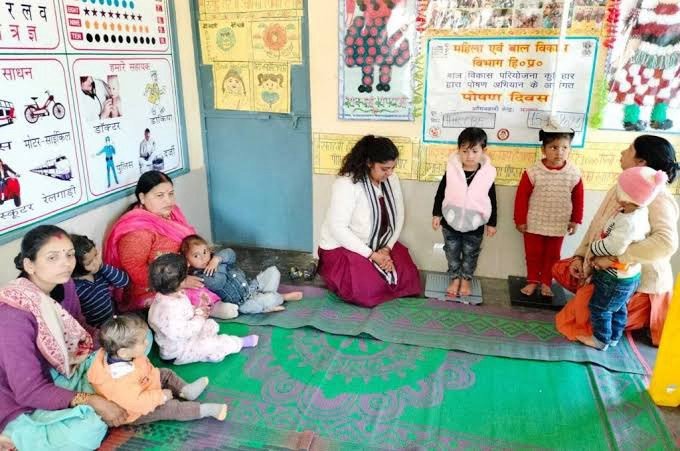
For thousands of children living in villages, remote mountainous areas and economically weaker families across Jammu & Kashmir, the answer should begin with the Anganwadi Centre. It is intended to be the first institutional support system for early childhood care, nutrition, health awareness and pre-school learning. It should be a safe, active and welcoming space where young children receive nutrition, develop basic learning skills and are prepared for their transition into formal education.
Unfortunately, based on my personal visits and observations of Anganwadi Centres in different parts of Jammu & Kashmir, I have encountered a situation that demands serious public attention. In several places, Centres have appeared closed, poorly maintained or functioning far below the standards that the programme promises. In some cases, what exists officially as an operational Anganwadi Centre can appear on the ground to be little more than a locked room.
This cannot be dismissed as a minor administrative inconvenience. It is a question of accountability towards our youngest citizens.
Under Mission Saksham Anganwadi & Poshan 2.0, Anganwadi Services are designed to provide an integrated package of supplementary nutrition, pre-school non-formal education, nutrition and health education, immunisation, health check-ups and referral services. The programme recognises early childhood care and education for children in the three-to-six-year age group as an important foundation for their development.
Therefore, an Anganwadi Worker is not merely responsible for distributing food. The Anganwadi system has a much larger purpose. It is supposed to contribute to nutrition, early learning, child development, growth monitoring, health awareness, identification of vulnerable children, interaction with parents and preparation for formal schooling.
That is an enormous responsibility. It deserves equally serious monitoring.
Yet the gap between government policy and ground reality can sometimes be deeply disturbing.
During my visits to different Anganwadi Centres, I have personally observed situations that raise serious questions: Centres that were not functioning properly, inadequate participation of children, little evidence of meaningful pre-school activities and a general absence of the vibrant learning environment that a Centre for young children should provide. There are also concerns at the grassroots level regarding the regularity and transparency of supplementary nutrition distribution and whether official records always correspond with what is actually happening on the ground.
I have encountered conditions so poor in some areas in Budhal Assembly segment that, based purely on my personal field observations, it has appeared to me that a very large proportion—at times approaching 70 per cent of the Centres I encountered—were either closed or effectively defunct. I want to make an important distinction: this is my personal field observation and not a claim that 70 per cent of all Anganwadi Centres in Jammu & Kashmir are officially classified as defunct.
But if such observations are considered incorrect, there is an extremely simple way to settle the matter.
Open the Centres without prior notice. Count the children. Verify attendance. Check the nutrition stocks. Speak to parents. Observe the pre-school activities. Examine the registers. Compare physical stock with recorded stock. Verify whether reported home visits actually took place. The truth will quickly become visible.
We have become far too comfortable with paperwork. A register is maintained. Attendance is entered. Reports are submitted. Meetings are recorded. Photographs may be uploaded. Statistics can look impressive.
But the most important question is often the simplest one: what actually happened to the child?
If a register records ten children, were ten children actually present? If nutrition is shown as distributed, did those children actually receive it? If a Centre is officially recorded as open, was its door actually open? If pre-school education has been reported, what learning activity was conducted? If a child was identified as vulnerable or malnourished, was follow-up action taken? If a home visit was recorded, did anyone actually visit that home? This is the difference between administrative compliance and genuine public service.
These concerns are not entirely new. Earlier audit findings concerning Jammu & Kashmir’s implementation of the Integrated Child Development Services programme had documented deficiencies in test-checked Anganwadi Centres, including problems relating to verification of home visits, health and growth surveillance, referral documentation and supplementary nutrition. Those findings relate to the period examined by the audit and should not automatically be presented as evidence of the current condition of every Centre.
But they demonstrate an important point: the Anganwadi system in Jammu & Kashmir has faced accountability and implementation challenges before. The question today is whether those weaknesses have been genuinely corrected.
Perhaps the most sensitive issue concerns supplementary nutrition.
The food and nutrition provided under government schemes are not departmental property. They are not a benefit for employees. They are not a private entitlement. They are intended for vulnerable beneficiaries—primarily children and women covered under the programme.
Therefore, whenever there are credible allegations that nutrition meant for children is being diverted, improperly distributed, taken away or otherwise misused, the allegations deserve an impartial investigation.
I have personally heard and encountered concerns at the grassroots level about the handling of nutrition supplies. I am not suggesting that every Anganwadi Worker or Helper is corrupt. That would be both unfair and irresponsible. There are undoubtedly many sincere workers who serve children in difficult conditions, often in remote and mountainous areas.
But the honesty and dedication of sincere workers cannot become a shield for misconduct by anyone who abuses the system.
Every credible complaint concerning diversion or misuse of children’s nutrition should be independently verified. Where wrongdoing is established, action should be swift and uncompromising.
Because taking away food intended for a vulnerable child is not simply a violation of a departmental procedure. It is a betrayal of public trust.
The real victims are children from families who have the fewest alternatives.
An affluent family can compensate for a dysfunctional Anganwadi. Parents may arrange private pre-school education. They may provide additional nutrition at home. They may have access to doctors, tutors and other support systems.
But what about a child whose parents are daily-wage workers? What about a child living in a remote village or tribal area? What about a family struggling to meet even basic nutritional needs?
For such a child, the Anganwadi may be the only institutional support available.
When that institution fails, there may be no alternative.
This is why the issue is especially important for Jammu & Kashmir, where difficult terrain, scattered settlements and remote communities can make access to other services challenging.
And then there is pre-school education.
The words sound impressive in government documents, but they must have meaning on the ground. A three-to-six-year-old child should experience learning through play, stories, activities, language development, movement, creativity, social interaction and age-appropriate educational concepts. The objective is to build confidence, curiosity and basic developmental skills before the child enters primary school.
Early childhood education is not babysitting. It is not simply keeping children in a room. And it certainly cannot be reduced to distributing food and sending them home. If a Centre remains closed, or if children attend without meaningful educational engagement, we are failing to provide the developmental opportunity the programme was created to deliver.
At the same time, accountability should not stop at the Anganwadi Worker. If a Centre remains closed repeatedly, how does the supervisory system fail to notice? If attendance appears perfect on paper but children are absent on the ground, who verifies the records? If nutrition stocks do not match official records, who is responsible for verification? If monthly reports show excellent performance while field conditions tell another story, who checks those reports?
The responsibility must therefore extend through the entire supervisory chain—from the Anganwadi Centre to supervisors, Child Development Project Officers, District Programme Officers and the higher administrative authorities responsible for monitoring implementation.
A dysfunctional Centre operating for months or years is not simply an individual failure. It can also represent a failure of supervision. Jammu & Kashmir should therefore consider a comprehensive, district-wise Surprise Anganwadi Verification Drive.
It should not be another inspection announced several days in advance, giving everyone sufficient time to prepare registers and arrange photographs. It should be a genuine field verification exercise.
Inspectors should verify whether Centres are physically open during working hours, whether workers and helpers are present, whether registered children actually attend, whether meaningful pre-school activities are being conducted, whether supplementary nutrition is available and distributed, whether physical stocks match official records, whether growth monitoring is taking place, whether health and referral services are being coordinated and whether parents are actually receiving nutrition and health education.
Most importantly, official records should be tested against physical reality.
The Government’s Poshan Tracker provides an important opportunity in this regard. Digital monitoring can help track Anganwadi Centres, workers and beneficiaries and provide information on areas such as Centre opening, child attendance, early childhood education activities, growth monitoring and supplementary nutrition.
But technology alone cannot solve the problem. A digital record is only as reliable as the information entered into it. Therefore, Jammu & Kashmir needs a three-layer accountability system:
Digital records + surprise physical verification + community monitoring.
Parents must become an important part of this process.Every Anganwadi Centre should prominently display basic information, including the number of registered beneficiaries, services available, nutrition entitlements, working hours, responsible functionaries and grievance-contact details. Wherever appropriate and legally permissible, information concerning supplies and distribution should also be made transparent.
Parents should be able to report a simple fact: “The Centre is closed.” Or: “My child did not receive the entitled nutrition.” Or: “No pre-school activity is taking place.” And every complaint should have a tracking mechanism and a clearly defined outcome. At the same time, we must protect and encourage honest Anganwadi Workers and Helpers. Many serve in difficult conditions and deserve proper training, facilities, educational materials and institutional support.
The principle should be straightforward: Support the sincere. Train the weak. Correct the negligent. Punish proven misconduct. There should be no collective condemnation of workers, but neither should there be a culture of impunity.
Anganwadi Services must also remain above local politics. Beneficiaries should not have to approach a politician to receive something to which they are already entitled. Workers should not feel protected from accountability because of political influence. Supplies must not be distributed according to connections, favouritism or pressure.
Children’s nutrition cannot become a political commodity. Jammu & Kashmir is investing in roads, infrastructure, tourism, technology and education. All of these are important. But the most valuable investment remains human capital, and human capital begins in early childhood. If a child enters primary school undernourished, without adequate early-learning exposure and without proper developmental support, that child begins the educational journey with a disadvantage.
Therefore, strengthening Anganwadis is not merely a Social Welfare Department issue. It is simultaneously an education issue, a health issue, a nutrition issue, a poverty-reduction issue and, ultimately, an issue concerning the future of Jammu & Kashmir.
The administration should undertake a transparent assessment of Anganwadi Centres across the Union Territory and publish district-wise results. The public should know how many Centres are genuinely functional, how many have regular attendance, how many conduct meaningful pre-school activities, how much nutrition was allocated, how much was distributed, how many complaints were received, how many were investigated and what action was taken.
Transparency is not an attack on government. Transparency is how public trust is built. And ultimately, there is one final test for every government programme: the beneficiary. For Anganwadi Services, that beneficiary is often a child too young to complain. That child cannot file an RTI. That child cannot write a newspaper editorial. That child cannot question an officer. That child cannot demand that the food allocated in his or her name actually reaches them. The child depends entirely on responsible adults. That is why the responsibility is enormous.
We cannot accept a system in which a Centre is shown as functioning on paper while its door remains locked on the ground. We cannot allow nutrition meant for vulnerable children to disappear into an opaque system. We cannot call it pre-school education when meaningful learning is absent. And we cannot claim to be building a stronger Jammu & Kashmir while neglecting the institutions responsible for its youngest citizens. It is time for an Anganwadi Accountability Revolution.
Open every Centre. Verify every record. Count every beneficiary. Track every kilogram of nutrition. Observe every classroom activity. Listen to every parent. Support every honest worker. Investigate every credible complaint. And take firm action wherever negligence, diversion or corruption is established. Because an Anganwadi is not merely a government building. It is a promise made to a child. And in Jammu & Kashmir, it is time we started keeping that promise.